Top 5 HireVue Alternatives | Compare Features and Cons
Automated Video InterviewingJuly 1, 20268 MIN READ
Looking for something specific?
Check out the filters!
How did it go the last time you had to hire someone?
Chances are, it involved a lot of time, effort, and stress. Sifting through resumes, coordinating schedules, asking the same questions over and over – it’s enough to make anyone wish for a better way.
Well, that “better way” is here, and it’s called an AI interview agent. And no, this isn’t just another tech buzzword – it’s a real solution to the challenges recruiters and hiring managers face every day.
Designed to help in everything from screening candidates to conducting interviews, these interview AI agents make the process smoother, faster, and more effective.
But what exactly are they, and how do they work? And why are they such a big deal for recruiters, hiring managers, and even job seekers? Let’s find out.
Agentic AI, a term that’s gaining traction in the tech world, refers to artificial intelligence systems that are designed to act autonomously, almost like a virtual assistant with a purpose.
Unlike simpler AI models that passively generate responses based on prompts, agentic AI can take initiative, adapt to new information, and refine its actions over time. Like making decisions, and executing complex tasks without requiring constant human input.
This ability to act autonomously and intelligently in dynamic environments has paved the way for innovations across industries – including recruitment.
An AI interview agent is a virtual hiring assistant that goes beyond asking or answering questions – it actively conducts interviews, evaluates responses, and refines its approach based on feedback.
It helps recruiters pre-screen candidates, streamline evaluations, ensuring faster and more data-driven hiring decisions.
Interview AI Agents function as a virtual interviewer that conducts initial screening interviews on behalf of HR teams.
The process is straightforward – recruiters set up a list of interview questions on the platform, invite candidates, and the AI handles the rest.
Ideally, candidates receive a link to record their responses – usually via webcam or smartphone – at their convenience rather than scheduling a live call.
Once those video responses are submitted, the AI springs into action.
Behind the scenes, the system uses artificial intelligence to evaluate each candidate’s answers.
It analyzes what the candidate says (and sometimes how they say it) to gauge job-related competencies, communication skills, domain knowledge, and even language proficiency.
After processing the responses, an Interview AI Agent would automatically score and rank the candidates based on their performance.
In essence, it delivers a data-driven shortlist of the top applicants to the human recruiters, who can then review detailed reports and video recordings to decide whom to advance to in-person interviews.
Interview AI agents typically include AI-powered video proctoring to ensure the integrity and fairness of these AI-driven interviews.
It has the ability to confirm that the correct person is taking the interview and monitor for any suspicious behavior during the recording.
For recruiters and HR professionals, the payoff of using an AI assistant is tangible. The Interview AI Agent can shoulder the heavy lifting of early-stage hiring, delivering several key benefits.
Automating initial interviews dramatically cuts down the time needed to vet applicants.
In practice, some organizations that adopted AI interview platforms have reported even greater time savings – up to 4X reduction in hiring time in certain cases.
Roles that once took months to fill can now be filled in weeks, which is a game-changer in competitive talent markets.
An AI agent can screen hundreds of candidates simultaneously, something impossible for a human team to do with the same speed.
This scalability means HR departments can handle high-volume hiring without ballooning workloads or burnout.
In short, routine screening tasks that used to consume days of recruiters’ time are handled in minutes by AI, allowing human recruiters to focus on the more nuanced parts of hiring.
Every applicant answers the same preset questions under the same conditions, and the AI grades them against the same criteria.
This standardization helps eliminate the variability (and potential unconscious bias) that can occur in human-led screenings.
The results can be encouraging for diversity and inclusion.
By focusing on data over gut feel at the preliminary stage, AI tools help level the playing field for candidates from different backgrounds.
Candidates often find AI-led prescreening more convenient. Instead of taking time off work for a phone screen or traveling to an office for an initial interview, applicants can record responses on their own schedule – be it over a lunch break or late at night.
This flexibility not only removes scheduling headaches, it also tends to reduce candidate stress. They can put their best foot forward when they’re ready, rather than being caught off-guard by an unexpected call.
Every AI-screened interview yields rich data that recruiters can use to make informed decisions.
An Interview AI Agent doesn’t just pass or fail a candidate – it provides detailed analytics, from transcripts of what the candidate said to scores on various competencies.
Hiring managers can review these insights to understand why a candidate did well or poorly, and compare candidates on specific skills.
Over time, this accumulation of data can even help refine the hiring process itself.
Patterns might emerge showing which traits correlate with success in a role, guiding recruiters to what questions or answers matter most. With decisions backed by data, companies ultimately stand to improve the quality of their hires.
ZappyVue, our automated video interviewing technology has the ability to screen candidates automatically.
All you need to do is set up questions, either from a template or customize your own. Then you can just send off invites to candidates who can take the interview at their own convenience, while you get detailed, AI-powered reports on each candidate.
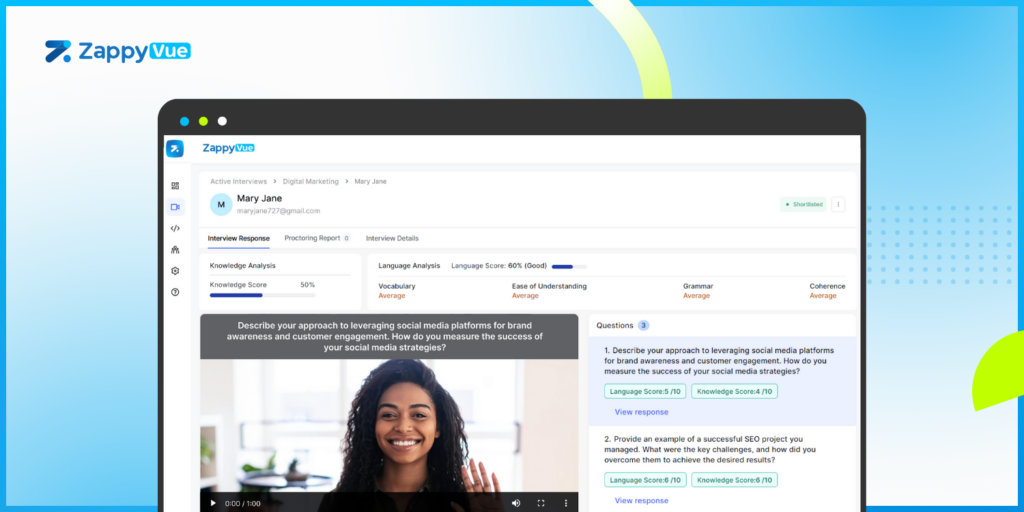
By the time ZappyVue completes its analysis, recruiters have a clear, unbiased evaluation of each candidate – generated in a fraction of the time compared to manual screening.
The rise of AI-driven screening doesn’t mean the old ways were all bad – it’s more of an evolution to meet new hiring challenges.
Traditional hiring methods have long relied on humans at every step – HR staff would manually sort resumes, conduct phone screens, and schedule face-to-face interviews.
It’s not uncommon for a popular job posting to attract hundreds or thousands of applicants, which can overwhelm recruiting teams.
With the advancement of this tech, it’s important for recruitment teams to automate tasks that don’t require human intervention, allowing AI to handle the heavy lifting.
Hiring managers and HR professionals who embrace this technology early may find themselves at a distinct advantage, able to make smarter hires faster than their competitors.
At the same time, job seekers might start encountering AI agents as their first interviewer more often.
With clear communication and a candidate-friendly design, this shift can feel like a natural extension of the digital world they already navigate.
But in the end, recruitment will always be about people making decisions about people.
Discover how Zappyhire helps large, multi-location hiring teams accelerate recruitment with AI-driven automation.
Schedule Demo