ATS Implementation: 9 Steps to a Smooth Rollout for Enterprise Teams
ATSSeptember 3, 202613 MIN READ
Looking for something specific?
Check out the filters!
Artificial Intelligence (AI) has quietly been influencing recruitment for over a decade – starting with resume parsing and automated job-matching, then evolving into chatbots, predictive analytics, and AI-driven video interviewing.
But 2025 marks a tipping point. For enterprises, the conversation is no longer “Should we integrate AI into recruitment?” It’s “How fast can we do it, and how do we do it right?”
In the recent panel discussion The Enterprise Hiring Paradox: Speed vs. Quality at Scale, industry leaders explored why AI has become indispensable in enterprise recruitment, the integration challenges they face, and how to balance automation with the human touch.
The panel featured:
The conversation revealed why AI adoption has accelerated and how enterprises can approach it strategically.

Enterprise hiring has evolved from filling positions to orchestrating complex, high-stakes talent acquisition ecosystems.
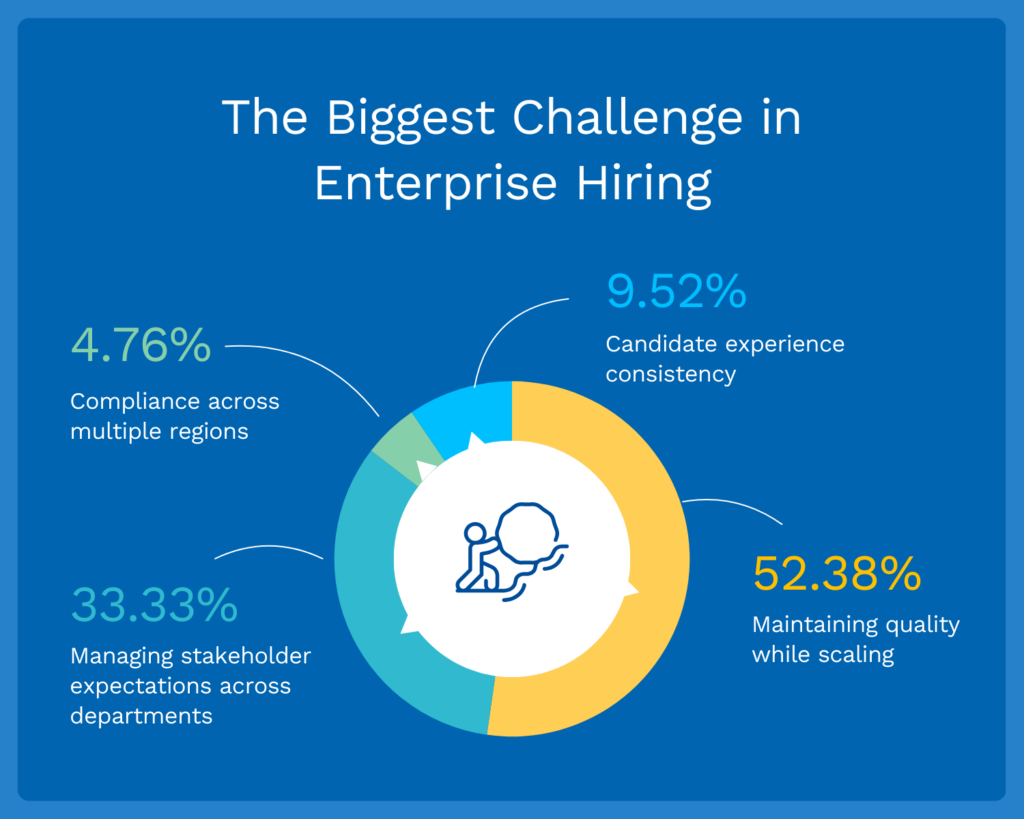
“What works for 50 hires a year will break completely at 1,000 hires.”
— Deepu, Zappyhire
This is where AI in recruitment becomes critical. It’s not a silver bullet, but without it, the speed–quality trade-off becomes unmanageable:
AI in recruitment promises a third path: scaling without sacrificing quality.
One of the most striking messages from the panel was that AI in recruitment is shifting from a support tool to a strategic enabler.
“AI will not replace HR professionals. But HR professionals who embrace AI will replace those who don’t.”
— Deepu Xavier, Zappyhire
In the early days, AI in recruitment was mostly about efficiency… reducing manual effort in resume screening, scheduling, and status tracking. Now, it’s about enabling better hiring decisions by:
Samira noted that AI must enhance, not replace, the personal touch that defines great hiring experiences:
“Employer branding and personal touch are core to enterprise hiring – AI will protect and enhance that, not erode it.”
— Samira Dash, HR One
Buying an AI recruitment tool is easy. Making it work seamlessly in an enterprise tech stack? That’s the challenge.
Keerthy highlighted the need for application landscape mapping before onboarding AI.
Deepu took it further with a vision for proactive recruitment:
“If an HRMS records a resignation, the AI recruitment system should detect it, search the talent pool, engage candidates, refresh resumes, and queue them for review—so by the time the recruiter logs in, the shortlist is ready.”
This isn’t just convenience, it’s a huge advantage in a market where timing is everything.
The panel’s insights revealed that AI has touchpoints throughout the hiring process.
While AI in recruitment can dramatically speed up screening, it’s not flawless.
“In raw form, AI can deliver 60–70% accuracy. Moving beyond 90% is the real challenge—it requires human feedback loops and enterprise-specific tuning.”
— Keerthy Krishna Swamy, Digital Transformation Specialist
This is why Deepu warns against seeing AI as a replacement:
“The work will change, but it won’t disappear. AI should make hiring more human, not less—by freeing recruiters to focus on the people who matter.”
— Deepu Xavier, Zappyhire
A recurring concern was trust. How can recruiters trust AI recommendations without understanding how they’re made?
Deepu compared it to buying a pressure cooker:
“Even if you don’t fully understand what ISI certification means, you look for it because it signals safety and quality. AI in recruitment will need similar recognized standards.”
And we couldn’t agree more!
Responsible AI in recruitment means:
Without these, AI adoption will face resistance – especially in heavily regulated industries.
Not all teams can roll out AI organization-wide from day one. Deepu offered a pragmatic roadmap:
This incremental approach builds credibility and internal champions for AI in recruitment.
Beyond speed and efficiency, compliance and security were seen as foundational to scaling AI in recruitment.
Samira explained:
“When we’re hiring across geographies, every region has unique expectations and legal requirements. Without compliance in place, we can’t scale effectively.”
Compliance isn’t a “brake” on hiring – it’s the guardrail that allows fast, safe scaling. Embedding compliance checks into AI tools ensures recruiters can move quickly without second-guessing legal or policy risks.
The panel closed with a clear consensus. AI will become central to enterprise hiring, but human recruiters will remain at the core.
“HR must come out of its comfort zone, understand numbers and technology, and embrace it—for personal growth, organizational success, and the industry’s future.”
— Samira Dash, HR One
“Automation can save 40% or more of recruiters’ time on administrative tasks like scheduling. That’s time that should be spent engaging with candidates.”
— Keerthy Krishna Swamy, Digital Transformation Specialist
“Technology parity is fast—features get copied in weeks. The real differentiator will be how responsibly, ethically, and explainably we use AI.”
— Deepu Xavier, Zappyhire
Enterprises that adopt it early, responsibly and intelligently, will not just fill roles faster; they’ll build stronger, more engaged teams without sacrificing the human touch that defines great organizations.
Discover how Zappyhire helps large, multi-location hiring teams accelerate recruitment with AI-driven automation.
Schedule Demo