How to Hire Faster with These 9 Strategies
AI Adoption in HiringAugust 3, 202610 MIN READ
Looking for something specific?
Check out the filters!
January doesn’t ease hiring teams back into work. It snaps everything back into motion.
People return from December breaks. Hiring plans unfreeze. Backlogs turn into priorities. And suddenly, the questions aren’t “what next?” – they’re “how fast can we move?”
At Zappyhire, we’ve been easing that pressure by making sure hiring doesn’t stall atany step of the hiring lifecycle.
Over the past year, we’ve worked on removing friction where it actually slows teams down: screening bottlenecks, delayed shortlists, and manual decision loops that stretch timelines for no good reason.
The result has been product updates that aren’t just new, but practical – built to help teams move candidates forward with less effort and more clarity.
As we step into 2026, what’s old and what’s new at Zappyhire is tied by a single goal: helping hiring move faster, cleaner, and with far less effort from recruitment teams.
If we had to describe 2025 in one sentence, it would be this – Hiring wasn’t broken. It was just getting stuck.
Candidates stalled between stages. Interview feedback arrived late. Credits ran out without anyone noticing. Reports existed, but not when someone urgently needed an answer.
None of these were dramatic failures. But together, they stretched time-to-hire in ways that were hard to see and harder to fix manually.
So instead of asking what big feature should we ship next?, we started asking smaller, more uncomfortable questions:
What followed was a year of unglamorous, but deeply meaningful, changes.
One of the earliest patterns we noticed was how much effort went into reminding.
Reminding candidates to complete interviews.
Reminding interviewers to submit feedback.
Reminding recruiters that a job was about to close.
Everyone was doing the right thing, just too late.
So instead of adding more checklists, we leaned into something simpler: let the system remember things humans shouldn’t have to.
That’s how automated reminders quietly expanded.
Candidates started completing interviews more consistently.
Recruiters stopped manually following up on deadlines.
Hiring managers didn’t have to be chased for approvals as often.
Nothing flashy. Just fewer dropped balls.
And in hiring, that’s a big deal.

As hiring momentum returned and volumes started climbing, we also saw several large companies adopt Zappyhire – often in the middle of active hiring cycles, with little room for trial and error.
Some of the more prominent organizations that began working with Zappyhire during this phase include Himalaya, HDB Financial Services, upGrad, and Lennox, among others.
A common thread across these teams was where they were in their AI journey. Most weren’t new to recruitment technology. They had already experimented, piloted tools, and seen what worked – and what didn’t – at scale.
What they were actively looking for was something more dependable: AI that fit into real hiring workflows, automation that reduced effort without reducing control, and systems that could be trusted once hiring moved beyond experimentation.
In that context, Zappyhire simply proved to be the better fit.
Another theme that kept coming up(especially with growing teams) was visibility without micromanagement.
As automated video interviews with ZappyVue scaled, credits became a surprisingly emotional topic.
Who used them? Where did they go? Why were they gone already?
The problem wasn’t misuse.
It was shared pools without clarity.
So we rethought how control should actually feel.
Credit distribution in ZappyVue gave admins a clear mental model:
Once that structure was in place, teams stopped worrying about usage and went back to focusing on candidates.
That’s been a recurring pattern for us – When systems are predictable, people relax.
Let’s talk about reports.
Most hiring platforms technically have them. The frustration comes from finding the right one at the right moment.
In 2025, we stopped thinking of reporting as a destination and started treating it as infrastructure – something that should quietly support decisions, not demand effort.
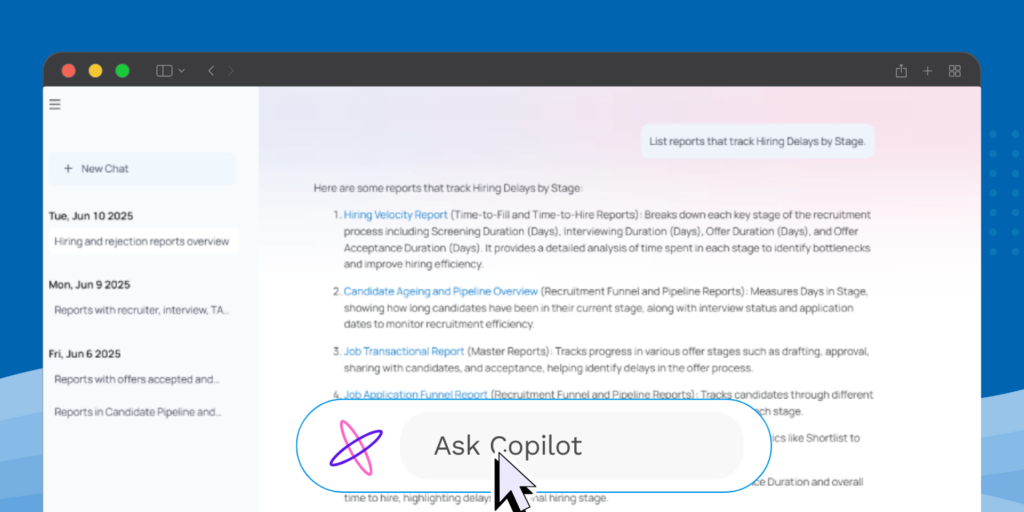
That led to:
And eventually, one honest realization – People shouldn’t need to know report names to get answers.
That’s where the Report Finder Copilot came in – not as AI theatre, but as a practical shortcut. Ask a question in plain English. Get pointed to the right data. Move on.
Hiring decisions don’t happen in calm moments. Reports shouldn’t slow them down.
Some of the most impactful changes in 2025 didn’t come from big roadmap items. They came from watching how recruiters actually move through the system.
Opening a candidate profile.
Switching tabs.
Scrolling.
Clicking back.
That friction adds up.
Candidate Quick View was born from that observation. Not to replace full profiles, but to respect how decisions really happen: quickly, in context, often mid-conversation.
When recruiters started telling us they were moving candidates faster without realizing why, we knew we were on the right track.
We spent a lot of time in 2025 listening to how teams talk about AI when they’re being candid—especially during webinars and closed-door discussions.
So yes—nearly 8 in 10 organizations have begun their AI journey in recruitment.
But fewer than half are confident enough to run it meaningfully at scale.
And that gap matters.
Because this data doesn’t point to a demand for more automation. It points to a demand for clarity, control, and confidence.
Teams aren’t asking “Can AI do this?” anymore.
They’re asking “Can we rely on it—and explain it?”
That’s the lens we’re carrying into 2026.
On that note…
We’re being intentional about what we build next—and just as intentional about what we don’t overpromise.
Our focus isn’t on adding more AI for the sake of it. It’s on solving the exact friction points teams hit once they move beyond pilots and into real-world usage.
Here’s where that investment is going.
We’re doubling down on making automation more agentic, contextual, and reliable—not just faster.
That means:
The goal is simple: reduce operational load without reducing recruiter control or visibility.
On the assessment side, the focus is depth—not just speed.
We’re investing in:
This is about helping teams make decisions they can stand behind, especially at scale.
Nothing flashy. Nothing speculative.
Just building what teams actually need once AI moves from interesting to mission-critical.
If your team is an avid user of Zappyhire, or just getting started, a few focused tweaks can make a noticeable difference to how smoothly your hiring runs this year.
If you’re already using Zappyhire:
These are small changes, but they compound quickly at scale.
If you haven’t tried Zappyhire yet:
If you’re evaluating ATS or recruitment automation platforms, a short walkthrough can help you see how Zappyhire fits into your hiring process.
We’re happy to walk you through real workflows, role-specific use cases, and where automation actually saves time!
Discover how Zappyhire helps large, multi-location hiring teams accelerate recruitment with AI-driven automation.
Schedule Demo