
What is Enterprise Recruitment | Its Challenges & Process
ATSJuly 1, 20269 MIN READ
Looking for something specific?
Check out the filters!
92% of construction firms say they’re having a hard time finding workers to hire, according to the Associated General Contractors. Not “some difficulty” or “occasional gaps.” Nine out of ten firms, struggling.
Evidence from both mature and rapidly expanding construction markets points in the same direction. The construction industry needs hundreds of thousands of new workers each year to keep up with demand, while more than 40% of the current US workforce is expected to retire over the next decade.
In India, nearly half the industry’s workforce demand remains unmet, with an estimated 90.8 million workers needed but only around 48.3 million available.
Similar workforce pressures are visible in fast-growing markets such as India, where a Construction Skill Development Council of India study estimated that Indian states required approximately 90.8 million construction workers, while only about 48.3 million were available – leaving nearly 47% of demand unmet.
“The total requirement of skilled and unskilled laborers in the construction sector, including real estate, is 33 million per day. The shortage is around 30%. We need to take proper measures so that things do not worsen next decade when per day labor requirement will treble”
— Santosh Rungta, President, CREDAI
Here’s the thing, though – firms that are winning this talent race aren’t necessarily the ones throwing the most money at the problem.
They’re rethinking how they recruit, from where they source candidates to how they run assessments to how quickly they respond once someone applies.
So, we’re bringing you the top 5 recruitment strategies for construction companies that are proven to work.
Before diving into tactics, it helps to understand exactly what’s driving the crunch, because the causes shape which fixes actually work.
Raw demand outpacing supply
82% of firms report difficulty filling hourly craft positions, and 80% report difficulty filling salaried openings, which is the highest proportion in three years. And 45% of contractors say labor shortages are directly causing project delays
“Presently, there is no shortage of opportunities for qualified labor in the real estate industry, but a lack of skills is a major barrier to employability and paying decent wages for the workers.”
— Rajan Bandelkar, National President, NAREDCO
This skills gap is also pushing employers to reconsider how they evaluate candidates. Zappyhire’s Enterprise Hiring Trends & AI Adoption report found that across industries, 79.2% of organizations report at least some movement toward AI-enabled skills-based hiring.
However, only 11% have fully shifted away from degree-led criteria, showing that many employers still struggle to translate the idea of skills-first hiring into practice.
For construction companies, this means placing greater emphasis on trade skills, certifications, practical assessments, and job readiness rather than relying primarily on formal educational qualifications.
As the Boomer generation retires en masse, younger workers haven’t been entering the trades at a replacement rate.
For decades, “college-for-all” messaging steered students away from skilled trades entirely.
But that seems to be shifting, as a Wall Street Journal’s analysis put it, Gen Z is emerging as the “Toolbelt Generation,” drawn to trades through exposure to modern, tech-enabled construction work rather than the old image of purely manual labor.
Sourcing itself is disconnected from where talent actually is. Jennifer Wilkerson, VP of Innovations and Advancements at the National Center for Construction Education & Research, described this gap bluntly:
“I’ve been at contractor meetings before and I’ll say, ‘How many of you recruit from high schools?’ None of them raise their hand. ‘How many of you have issues right now with hiring people?’ All of them raise their hand.”
— Jennifer Wilkerson, NCCER
That disconnect, between where firms recruit and where the next generation of workers actually is (physically and mentally), shows up again and again across the strategies below.
As seen, skilled labor shortages, tight project timelines, and multi-site hiring make recruitment especially challenging for construction companies. These five strategies can help you attract qualified workers and reduce workforce gaps.
Build long-term relationships with Industrial Training Institutes, polytechnics, trade schools, community colleges, apprenticeship programs and local schools. These partnerships can include:
These partnerships are most effective when they form part of a broader strategy for attracting and hiring blue-collar workers across multiple talent channels.
Recruitment technology should support the entire construction hiring process, especially when companies are managing high-volume blue- and grey-collar hiring across multiple projects and locations.
This is particularly important when applications arrive through multiple sites, contractors, referral partners and staffing vendors. Without one source of candidate information, recruiters may lose track of applicants, repeat screening work or unknowingly process the same person several times.
A recruitment automation platform can help construction companies,
Duplicate detection that is built into your AI-powered applicant tracking platform is especially important in construction. The same candidate may be referred by a supervisor, submitted by a staffing partner and apply directly for the same role.
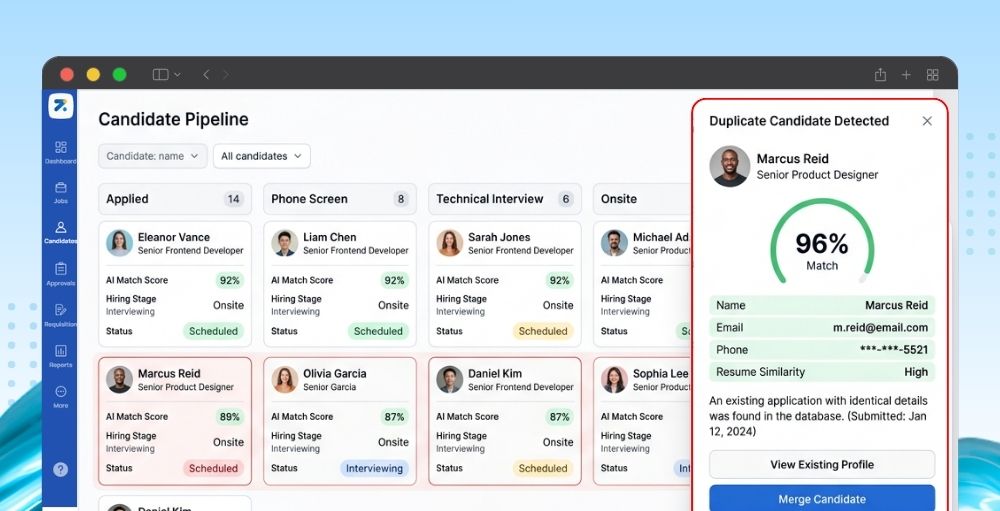
Automatically identifying and merging these records keeps the candidate database clean and prevents recruiters from repeatedly screening the same person.
Candidate quality also remains a major operational concern. In an AGC workforce survey, 57% of contractors said available candidates were not qualified to work in the industry, while 41% said candidates lacked required credentials such as licenses or work permits.
Zappyhire’s Enterprise Hiring Trends & AI Adoption Report found that 70.3% of organizations across industries use AI for resume screening and parsing, increasing to 81.7% among enterprise organizations. For construction employers, this technology can help prioritize candidates who meet predefined requirements while leaving final hiring decisions with recruiters and project teams.
“Construction costs in 2026 are expected to rise 3-5 per cent, driven by regulatory changes, skilled labor scarcity, and stricter environmental standards. Digital technologies help offset these pressures by improving efficiency and delivering greater project value.”
.
— Ashok VS, Head of Cost Management, JLL PDS, India.
Recruitment technology cannot create skilled workers on its own. It can, however, help companies use their existing candidate supply more efficiently and respond faster when project requirements change.
Construction firms have historically relied on referrals and word-of-mouth, which worked well when the workforce skewed older and more networked within the trades. That approach is increasingly out of step with how younger candidates actually discover jobs.
What has proven to work is partnering with trade schools and community colleges, showcasing real career-progression stories, and using platforms like TikTok, LinkedIn, and Instagram for job-awareness campaigns, rather than relying solely on traditional job postings.
For example, social media campaigns built around hashtags like #SkilledTrades and #WomenInTrades can also broaden visibility, support diversity, and help construction firms reach talent beyond traditional networks.
Construction employer branding should go beyond corporate videos and statements about being a “great place to work.” Candidates need practical information about what working for the company will actually look like.
Job advertisements and recruitment campaigns should clearly communicate:
Competition for skilled workers is already pushing employers to improve their employment offer. 95% of construction firms said they had increased base pay during the previous year, while 53% provided larger raises specifically to attract hourly craft workers.
Use real employee stories to demonstrate how someone can progress from an apprentice or site worker into a supervisory, technical or project-management position. Show candidates the equipment, technology, safety standards and working conditions they can expect, not just completed buildings.
Every experienced worker retained or successfully moved to another project is one fewer vacancy the recruitment team must fill.
Instead of allowing relationships to end when a project is completed, construction firms can maintain a reusable talent community of:
Record each person’s trade, certifications, preferred locations, project history, availability and willingness to travel. When a project timeline changes, recruiters can approach workers who are already known to the organization rather than starting the search from zero.
It is significant and seems to be worsening. 92% of firms report difficulty finding workers, and the industry needs roughly 349,000 net new workers in 2026 alone, climbing to about 456,000 in 2027.
Some of the best strategies include automating eligibility screening and candidate communication as they typically deliver the quickest wins in construction recruitment – since both remove manual bottlenecks without requiring long-term structural change.
Construction companies can attract Gen Z workers by showing up where Gen Z actually looks for jobs. Social platforms like TikTok and Instagram, partnering directly with trade schools and community colleges, and reframing trade careers around modern technology, clear growth paths, and competitive apprenticeship pay rather than the outdated image of purely manual labor.
Discover how Zappyhire helps large, multi-location hiring teams accelerate recruitment with AI-driven automation.
Schedule Demo