Top 5 HireVue Alternatives | Compare Features and Cons
Automated Video InterviewingJuly 1, 20268 MIN READ
Looking for something specific?
Check out the filters!
Recruiters and hiring managers are often overwhelmed by the sheer volume of applicants, each with unique stories and potential.
So how can you ensure that you’re selecting the best fit for your team?
The answer lies in the power of structured interviews.
This method transforms the interview process from a chaotic guessing game into a strategic, efficient, and fair evaluation.
Even industry giants recognize its value. For instance, Google uses structured interviews to enhance their hiring process, ensuring they consistently select top talent.
So with structured interviews, you can walk into every interview with a clear roadmap, confident in your ability to uncover the true potential of each candidate.
A structured interview is a standardized method of interviewing candidates for a job position.
Unlike traditional unstructured interviews, where the questions and flow of conversation can vary widely between candidates, structured interviews follow a predetermined format.
The primary purpose of a structured interview is to make sure every candidate is evaluated fairly and consistently.
It is only by asking the same set of questions in the same order, you can ensure that each person is assessed on the same criteria.
This helps you see how well candidates meet the job requirements and compare their responses more easily.
In short, structured interviews aim to provide a level playing field where everyone gets a fair shot, and you can make more objective and reliable hiring decisions.
The choice between structured and unstructured interviews can make a significant difference in the quality of hiring decisions.
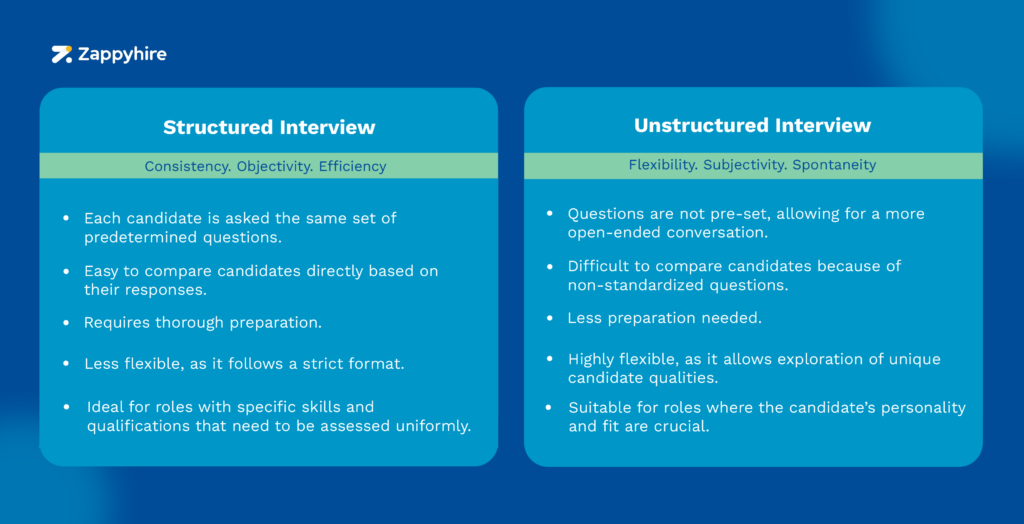
Unstructured interviews are informal, with no fixed questions or scoring system. Interviewers rely on their intuition, allowing for a more conversational and flexible approach. While this can make candidates feel more at ease, it also introduces several drawbacks such as,
Inconsistency – Different candidates may face different questions, making it hard to compare responses fairly. This variability reduces the reliability of the interview as a selection tool.
Interviewer bias – The subjective nature of unstructured interviews increases the risk of interviewer bias. Personal impressions and unconscious biases can skew evaluations.
Lower predictive validity – Studies show that unstructured interviews have a mean validity of only 0.38 for predicting job performance. Even when combined with General Mental Ability (GMA) tests, their combined validity reaches only 0.63.
Structured interviews follow a rigorous format with predetermined questions based on job-related competencies. This standardization ensures that each candidate is assessed on the same criteria, leading to several benefits compared to unstructured interviews, such as,
Consistency – All candidates answer the same questions in the same order, allowing for objective comparisons. This consistency enhances the reliability of the interview process.
Reduced bias – By following a structured format, the influence of interviewer bias is minimized, leading to more equitable and fair hiring decisions.
Higher predictive validity – Structured interviews demonstrate a mean validity of 0.51 on their own. When paired with GMA tests, the combined validity jumps to an impressive 0.76, showcasing the superior predictive power of structured interviews.
Conducting a structured interview is simpler than you think. Structured interviews follow a certain pattern to bring consistency and fairness into the process.
Once you learn the beat of it, you’re set.
The first step in constructing a structured interview is to clearly define the job requirements and what you’re looking for in a candidate.
Start by outlining the key skills, qualifications, and traits needed for the role. This helps you come up with relevant questions that will dig into whether candidates have these qualities.
Essentially, it’s about figuring out exactly what you’re trying to find out so you can ask the right questions to get the answers you need.
It’s also helpful to familiarize yourself with each candidate’s resume before the interview.
Set a friendly and professional tone from the beginning. Greet the candidate warmly and explain the format of the interview. This helps them feel comfortable and ready to give their best responses.

In a structured interview, every candidate is asked the same set of questions in the same order.
For example, for a marketing manager position, all candidates might be asked, “Can you describe a time when you successfully led a marketing campaign from inception to completion?”
The same question is asked in the same way to each candidate, ensuring that responses can be compared on a like-for-like basis.
Stick to the pre-determined questions in the same order for each candidate. This consistency ensures that everyone is assessed on the same criteria. Listen carefully to their responses and take detailed notes.
Use a scoring system to rate each answer based on predefined criteria.
This could be a scale from 1 to 5 or another method that helps you assess how well each response aligns with the job requirements.
Each response is evaluated against established benchmarks or criteria, often using a numerical scale.
For instance, a candidate who provided a detailed example with measurable results might receive a score of 4 or 5, while a vague or less relevant answer might score lower.
This scoring system helps to keep the evaluation unbiased and consistent.
The questions in a structured interview are directly related to the job’s requirements.
They are designed to uncover specific information about a candidate’s past behavior, situational responses, and competency levels that are pertinent to the role.
Instead of asking general questions, a structured interview for a software developer role might include, “How have you handled a situation where a project deadline was at risk due to technical issues?”
This question targets skills relevant to the job, such as problem-solving and time management, ensuring the candidate’s experience is pertinent to the role’s demands.

Avoid letting personal biases influence your evaluation. Focus on how well the candidate’s answers match the job requirements and the criteria you’ve set.
Every candidate is asked the same series of questions in the same order. For a customer service representative position, this might include questions like, “How do you handle difficult customers?” and “Can you provide an example of how you resolved a conflict in a team setting?”
This consistency helps create a level playing field, where all candidates are given an equal opportunity to demonstrate their qualifications. It also increases the reliability of the interview process, making it easier to defend and justify hiring decisions.
After each candidate’s response, the interviewer should take thorough notes and record the numerical score based on predefined criteria.
For instance, if a candidate’s response to a question about teamwork is noted as “demonstrated strong collaborative skills and provided a specific example,” this documentation helps in reviewing and comparing responses later, and can also be used to justify the hiring decision if questioned.
Does this part sound tedious? Read on, because we have the perfect solution for that!
After all interviews are done, review your notes and scores. Compare candidates based on how well they meet the job requirements. This will help you make a well-informed and objective decision.
If appropriate, offer constructive feedback to candidates. This helps them understand their performance and can enhance their experience with your company.
You might think structured interviews can be boring because they follow a set pattern and you have to ask the same questions to every candidate.
Now, thanks to tech advancements, you can leverage the best of both worlds – the proven effectiveness of structured interviews and the modern convenience of AI-powered video technology.
| 🔖 Recommended Article A Recruiter’s Guide to Automated Video Interviews |
This approach not only makes the interview process more engaging and efficient but also enhances the overall candidate experience, making it anything but boring.
And what’s more? Asynchronous video interviews allow you to easily handle a large number of candidates, making it perfect for even roles with high application volumes!
If you want to start implementing automated structured interviews right away, you can just login to ZappyVue!
Discover how Zappyhire helps large, multi-location hiring teams accelerate recruitment with AI-driven automation.
Schedule Demo